Massachusetts Unemployment Drops to 8 Percent

The Massachusetts unemployment rate for March dropped to 8 percent, down from February’s rate of 8.2 percent, according to the state’s Executive Office of Labor and Workforce Development.

Massachusetts added 3,200 jobs in March, the sixth straight month of job gains. The largest gain in employment came in the leisure and hospitality sector of the local economy, and the construction sector had the largest growth rate, state officials said.

Sectors losing jobs included government and financial services. The March job gain follows a revised 14,400 jobs gain in February, previously reported as a 15,400 job gain, state officials said.

The national unemployment rate is 8.8 percent. In March 2010, the state’s unemployment rate was 8.7 percent.

The state said more than 3.2 million Massachusetts residents had jobs last month, while about 282,000 were out of work.

This improvement in the unemployment rate validates PSG’s experience; in 2011 we have seen steady increases in hiring from our clients.

Your Resume- What you need to know

As a job seeker, you will hear varied opinions about what you should and should not include on your resume. It is confusing, especially when the task of job searching can be so daunting as it is, when you hear conflicting opinions.

At PSG, we see hundreds of resumes daily. Our aim as a staffing agency is to understand where each person is coming from and where we might be a resource for them. In short, we look for the best in the resume, not for “strike-out” points. However, most employers do not take this approach, so it is important to know what things can send your resume to the discard pile quickly at most organizations.

This article talks about some of the pretty clear and unargued “don’ts” of resume writing.

Incivility in the Workplace

Are we becoming a nation of uncivil servants? The January shooting of Congresswoman Gabby Giffords prompted numerous politicians and media to illustrate how uncivil and hot-headed our nation has become. There were subsequent calls for “civil discourse” and our government attempted to lead by example by pairing Republicans and Democrats as seat-mates for the President’s State of the Union address. It’s easy to see how our hurried, stressed and litigation-prone society can be less fun to be around and some have noticed that attitude carrying over to the workplace. Uncivil behavior in the workplace is unpleasant and costly, but can be prevented.

What is incivility in the workplace?
According to Wikipedia, workplace incivility has been defined as: “low-intensity deviant behavior with ambiguous intent to harm the target… Uncivil behaviors are characteristically rude and discourteous, displaying a lack of regard for others.”

Examples of uncivil behavior at work can range from:

  • losing one’s temper or yelling at someone in public
  • rude or obnoxious behavior in the workplace
  • badgering or back-stabbing in the workplace
  • withholding important customer/client information
  • sabotaging a project or damaging someone’s reputation

To more subtle acts, such as:

  • arriving late to a meeting
  • checking e-mail or texting during a meeting
  • not answering calls or responding to emails in a timely manner
  • ignoring or interrupting a colleague in the workplace
  • not saying “please” or “thank you” when customary

In the book The Cost of Bad Behavior: How Incivility is Damaging Your Business and What to Do About It, authors Christine Pearson and Christine Porath interviewed workers at 800 employers, and found:

  • 96 percent have experienced incivility at work
  • 48 percent of employees claim they were treated uncivilly at work at least once a week
  • 10 percent said they witnessed incivility every day
  • 94 percent of workers who are treated uncivilly say they get even with their offenders

How did we get here?
It’s not hard to find examples of stress and hardship that could make people less civil: the tough economy, less than ideal employment situations, even the effect technology has on speeding up our communications and decision making, and lengthening our work hours by increasing our accessibility.

Some workplace observers even blame the slip in civility on the shift toward casual dressing, which causes more casual behavior and communication, in turn lowering standards of behavior. While casual dressing may or may not be a cause for incivility, it’s an example of the many workplace practices that have changed in our culture. When evaluating causes of incivility, employers should consider all the changes in their environments including the increased use of technology, teams that are more widely distributed geographically, and the increase in diverse workforces, to name just a few.

Workforce Management featured a January 2011 article, The Degeneration of Decorum, which reported that: “Incivility tends to rear its ugly head in organizations that have distinct pecking orders, where people are separated by rank…some experts say the worst fields for incivility are education and health care, where the abuse comes from the top and leads all the way down to the school playground or the operating room.”

The cost of uncivil behavior in the workplace
An uncivil workplace is an undesirable place to work or do business with. Incivility has wide-reaching impact on efficiency, effectiveness and job satisfaction in the workplace. Where uncivil behavior is found, it’s common to find poor communication and ineffective use of meetings, lower standards for customer service, decreased workplace productivity and lower rates for employee recruiting and retention.

As reported by Workforce Management: “In polling thousands of managers and employees about the effects of incivility, Pearson and Porath found that after being the victim of on-the-job rudeness and hostility, two-thirds of employees said their performance declined. Four out of five said they lost work time worrying about the unpleasant incident, while 63 percent wasted time avoiding the offender. More than three-quarters of respondents said that their commitment to their employer had waned, and 12 percent even quit because of bad treatment.”

What should employers do?
Employers and organization leaders are responsible for creating a foundation or environment where employees can shine. Office culture is often set from above, meaning that the management team needs to lead by example. Increasing awareness around incivility and its impact is a good place to start and, if necessary, create workplace policies around civil behavior where standards for acceptable behavior are established (just as you might create a policy for the use of social media).

HR managers can ensure that civil language and practices are imbedded into every level of an organization, including job descriptions, hiring practices, training policy and the day-to-day code of conduct. For example, use the hiring processes you’ve got in place, such as personality tests and reference checks, to look for signs of incivility in a candidate or new hire.

Other tips for fostering civility:

  • Recognize and reward employees who model strong civil habits – or empower employees to recognize their peers
  • Provide training and coaching to help employees identify problems
  • Foster open communication practices such as forums for sharing ideas and input, safe environments for sharing concerns or reporting incidents, and explain the importance of good communication and its impact on organizational success

Reducing incivility not only makes your organization a more enjoyable place to work, but it also has a positive impact on the bottom line through improved employee retention and performance.

Aaron Green is founder and president of Boston-based Professional Staffing Group and PSG Global Solutions. He is also the vice chairman of the American Staffing Association. He can be reached at Aaron.Green@psgstaffing.com or (617) 250-1000.


PSG Wins Best of Staffing Award

PSG is proud to announce that we have been named to Inavero’s 2011 Best of Staffing™ Client list for the second year in a row.  Best of Staffing, presented in partnership with CareerBuilder, is the nation’s only satisfaction award that recognizes exceptional client service within the staffing industry. Fewer than 1% of North American staffing firms have been named to the 2011 Best of Staffing Client List.

Staffing firms competing to make the Best of Staffing list underwent a rigorous client survey process followed by careful analysis of responses to determine satisfaction levels. PSG received satisfaction ratings of 9 or 10 out of 10 from 71 percent of their clients, significantly higher than the industry’s average of 33 percent.

“These are exciting times as the staffing industry is helping lead the way to renewed economic vitality,” said Eric Gregg, Inavero’s Founder and CEO.  “It has been estimated that staffing firms have helped to fill at least one quarter of the 93,000 new jobs opening up each month in North America over the past year. Along with the increase in demand for talented job candidates, companies engaging with staffing firms expect impeccable service more than they ever have. It is our hope that businesses searching for a staffing partner use the Best of Staffing List as a guide to firms that have truly outperformed the industry for the service that they provide.”

Inavero’s complete Best of Staffing list can be viewed at www.bestofstaffing.com. For more information about Inavero, visit www.inavero.com.

Print


Massachusetts Independent Contractor Law

Both the IRS and the Commonwealth of Massachusetts have had a heightened interest in misclassified independent contractors in recent years. The Federal and State governments have recently announced additional funds being allocated to hire more auditors because they anticipate a good return on investment. More auditors = more tax dollars found.

In general, business people tend to be more familiar with the IRS rules regarding independent contractors than with the state rules. The IRS follows a “common law test” for assessing the classification of contract workers, which is meant to reveal how much direction and control the business retains over the worker. The IRS developed a list of twenty factors to be used as an aid to apply the common law test. In addition to the federal test, Massachusetts employers have the state law to consider, which I am focusing this article on because:

Massachusetts law is more stringent than federal law
The Attorney General issued an advisory which stated, “The Massachusetts Independent Contractor Law (MICL) excludes far more workers from independent contractor status than are disqualified under the IRS common law test.”
As employers we should be paying closer attention to Independent Contractor law at the state level. Here are the requirements of Massachusetts law and their effect on businesses.
Massachusetts Law requires a three part test
The MICL creates a presumption that an individual performing any service is an employee. To overcome this presumption, the party receiving services must establish:

1.  that the worker is free from its control and direction in performing the service, both under a contract and in fact; and

2.  that the service provided by the worker is outside the employer?s usual course of business; and

3.  that the worker is customarily engaged in an independent trade, occupation, profession or business of the same type.

The law requires that all three parts of the test (sometimes called prongs) must exist in order for an individual to be classified as anything other than an employee. The burden of proof is on the employer, and the inability of an employer to prove any one of the prongs is sufficient to conclude that the individual in question is an employee.

Some examples of how the law will apply
Based on my interactions with businesspeople, prong two seems to be the most problematic and least understood, so I will illustrate the application of the law in this regard:

Example #1: An accounting firm brings in a painter to repaint their office and classifies as an independent contractor. Assuming this person meets the tests for prongs one and three, the classification is allowed because the work being done is outside the firm’s usual course of business.

Example #2: An accounting firm brings in an accountant to assist them during their busy season and classifies as an independent contractor. This would be a violation of prong two because the service provided is not outside the employer’s usual course of business.

It is significant to note that the MICL does not take into account where the work is performed as part of this assessment. I took the time to point this out because it is a common misconception that if an independent contractor works outside of the employer’s place of business (i.e. from home), that fact satisfies the requirements to be classified as an independent contractor when this is not the case; where the person works is not relevant.

Consequences of misclassification

When employers don’t understand the application of the law and misclassify someone as an independent contractor, there can be costly repercussions. Employers can potentially be responsible for FICA and Medicare taxes and can even be responsible for the federal and state taxes that “should have”been withheld from the employee. In addition, they can be responsible for state unemployment taxes, worker’ compensation, and overtime if applicable. Penalties can accrue and in certain cases (i.e. overtime) treble damages can be assessed. Even if unintentional, what is often intended as a cost savings strategy can turn into a costly oversight.

Summary

While the use of independent contractors is extremely important to many companies, it is an approach fraught with inherent risks. The increased government attention to independent contractors and the large penalties involved take these risks to a dangerous level for Massachusetts businesses. Businesses need to examine their independent contractor relationships to ensure they comply with the rules or alternatively consider taking the appropriate steps to restructure their relationships.
Aaron Green is founder and president of Boston-based Professional Staffing Group and PSG Global Solutions. He is also the vice chairman of the American Staffing Association. He can be reached at Aaron.Green@psgstaffing.com or (617) 250-1000.

Brightening Skies – Boston Globe article features PSG’s Frank Gentile

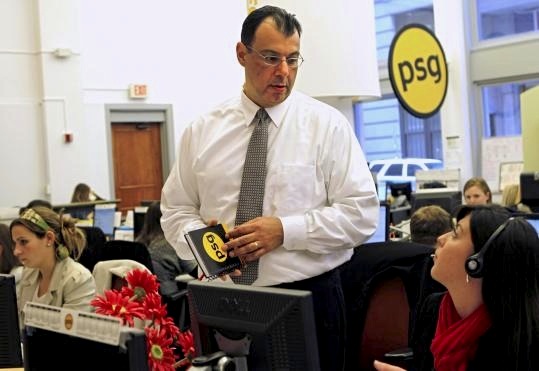
“Frank Gentile has been doing the impossible over the past few years. He’s been finding people jobs.” 539w We are pleased to see Frank Gentile, Senior Group Manager at PSG, featured in the Boston Globe’s Big Help special section on January 9, 2011.  The article offers an inside look at the job of a recruiter and the candidate/job matching process.

Check out the full story on Boston.com here.

Click here to follow Frank Gentile on LinkedIn.

Compensation Challenges Will Increase in 2011

For the past couple of years many employers have had the luxury of not needing to spend much time or energy on compensation issues. Loyal employees were happy to have a job and contribute to their organization without expecting pay increases. Now these employees feel it is time to be rewarded for their loyalty or at least be paid what they feel is fair for the work they are performing.

One might ask how I know employees are feeling this way. Two reasons: 1) surveys and other data and 2) first-hand experience.

  • Survey results suggest upcoming compensation challenges

According to a Right Management national survey released this week, 84% of employees plan to actively seek a new position in 2011.

The Labor Department’s survey known as the Job Openings and Labor Turnover Survey (also released this week) shows that advertised job openings are at their highest level since August 2008.

While these surveys don’t necessarily say employers will experience compensation challenges, they do say employees are open to new positions and new positions are becoming available. Combining these factors leads me to believe employees are going to be looking for raises to stay with their current employers.

  • First-hand experience

I manage a staffing firm that is currently experiencing an inflow of candidates who are looking for new opportunities solely because of money. While I’m excited to have the opportunity to represent these talented candidates, I want to help my readers and mention that in many cases it would not have taken much to retain these employees. In other words, employers are losing employees that they really shouldn’t be losing. To be clear, I am not talking about mercenary employees who constantly shop the highest bidder; I’m referring to otherwise loyal, talented employees who enjoy their existing job except for feeling underpaid and/or underappreciated.

My suggestions for managing compensation challenges:
Proactively address compensation challenges before they become an issue

Once a talented employee concludes that they are unfairly compensated and decides they would consider another job, it is probably too late and their employer has an uphill challenge trying to retain that person. Employers really need to address this challenge before it gets to the point where the employee feels taken advantage of. I can’t tell you how many times I talk to candidates who get counter-offers from their current employer and decline them. It typically does not even matter if the counter-offer is for more money then the job they are leaving to take. Don’t let this happen to you: address true compensation issues before it is too late.
Consider internal equity as well as the larger marketplace for talent

For many people the amount of pay is less important than its perceived fairness or equity. It is only natural for employees to compare their pay to someone who is doing the same job within the same organization. Some employees will compare their pay to employees doing a different job in the organization or with someone doing the same job in another organization.

Many times the comparisons are not exactly fair to the employer. Employees use positions that are not really comparable at all as benchmarks. Or they ignore parts of their compensation package and only focus on the parts that compare unfavorably. For instance, Employee A who has a high base salary and low bonus only wants to talk about his bonus and why it is lower than Employee B who has a low base salary. Regardless of whether the comparisons are fair or not, employers will need to deal with fairness issues if they want to retain staff.

It really is crucial to know the “market” wages for your company’s positions. There is a lot of information available: try the internet, industry trade organizations, or staffing firms- most will be happy to provide the information free of charge. The key is to be educated about fair pay in the marketplace; otherwise you run the risk of losing people.
Get creative with compensation and benefits

While we would like to pay everyone all they want to be paid, in the real world budget constraints exist. Look to maximize your budget by getting creative; I’ll give a couple of examples …

  • Flexible schedules

At my company we allow certain people very flexible schedules. The employees have certainly earned this benefit and they carry significant responsibilities. This benefit of a flexible schedule does not cost the company anything in hard dollars or even in management time to accommodate the flexibility. Yet the value to the employees is tremendous; from the employee’s perspective the quality of life value is worth tens of thousands of dollars. It is truly a “win-win” situation. I’ll mention that it took us some effort to make these situations work so that responsibilities could be managed, but the effort was well worth it.

  • Incentive based compensation

Let’s say you are faced with a situation where you just can’t pay someone any more money; maybe you are constrained by internal equity issues or maybe you have a budget challenge and you simply don’t have the money to spend. Consider developing a creative incentive plan that rewards the employee if more value is created from their work. If the employee is truly delivering more value it might justify the additional compensation or benefit. Incentive plans are certainly easier to create in sales environment but with some effort can be developed for all employees. My favorite incentive plans reward innovation and/or customer service.
Don’t “set it and forget it”

Commit to regular reviews of your compensation packages to ensure they are fair, equitable and competitive. Loyal employees may not mind waiting until their review date to bring up compensation concerns, but if there is no date or mechanism to raise their concern, the employee may get frustrated and leave.

Many employers will see compensation challenges in 2011. Don’t be caught by surprise; proactively manage compensation at your organization so you can retain your talented employees.
Aaron Green is founder and president of Boston-based Professional Staffing Group and PSG Global Solutions He is also the vice chairman of the American Staffing Association. He can be reached at Aaron.Green@psgstaffing.com or (617) 250-1000.
 

The Advantages of Temporary Employment

As the area’s leading locally based staffing agency, PSG employs close to 1,000 temporary employees on a daily basis.  Some of our folks choose contract work consistently as a career choice, while others do so to stay busy while on school breaks or to fill gaps between permanent positions.  This recent article discusses why more and more people are choosing temporary employment  in our modern economy.

Our temporary employees find many advantages to the flexibility of temporary work, including:

  1. Temporary assignments allow you to continue receiving a paycheck while conducting your job search.  Candidates whose ultimate goal is to find a permanent  job look at temping as a way to pay the bills while they are looking for their next long term job.
  2. Contract assignments allow our candidates to learn new skills and gain experience for their resume.  The diverse mix of industries that employment agencies work with allow temps who work on various assignments to pick up valuable experience and gain exposure to new software, terminology and business jargon than they would at a steady position within one field.
  3. It’s a working interview! The company may not have an opening to fill or the budget to hire you on permanent, but at the very least it is a networking opportunity.  The more people you meet (and impress!), the better for your permanent job search.
  4. Flexibility.  Our folks who choose to temp as a career enjoy the flexible work schedules and independence of contract assignments.

What do you think about temporary work as a career option?  What about temp work to fill in some of the gaps of unemployment?  Any success stories through temp work? Please feel free to comment below or email me at mstevenson@psgstaffing.com.

2010: A Look Back

by Aaron Green

The beginning of 2010 was still a dark period for most Boston workplaces. Salaries and compensation packages were static, employers and employees were tasked with doing more with fewer resources and in general there was still a lot of fear and unknown regarding the future. Since then, the economy has slowly improved. The unemployment rate has fallen; employers in the state have added nearly 50,000 jobs; and the state is doing better than the rest of the nation in terms of unemployment and economic expansion rates.  However, we’re certainly not back to pre-recession levels as unemployment is still historically high and there are still approximately 120,000 fewer jobs than when the recession began. In fact, many Massachusetts residents don’t feel a recovery has begun. A survey that my firm, Professional Staffing Group, conducts each quarter with our HR clients echoes this mixed outlook. Looking back at the quarterly surveys and reports we’ve produced with our clients, as well as the daily interactions we have with hundreds of Boston HR departments, here’s a snapshot of how far we’ve come this year and where we are now:

The Boston economy showed incremental improvement in 2010
Our economy is certainly not robust and not yet back to pre-2008 levels, but employers are adapting. According to our survey, most kept HR expenditures at a static rate throughout the year. And while the BLS projects that overall employment will increase by 10 percent in the next 5 years, Boston-area employers are only mildly optimistic. For the past 6 months, the HR managers and employers we’ve surveyed have said they plan to add staff (8 times as many said they’d add as those who said they’d cut staff). Yet, 52 percent say they expect staffing levels to remain the same.

Employer purse strings are starting to loosen
Employers are starting to offer compensation increases after having shelved these for several months.  In our most recent survey, 82 percent of employers said they expect compensation to increase in the next 12 months, up from 77 percent who said they expected an increase in last quarter’s survey.  Sixty-seven percent of employers surveyed said they actually increased compensation during the past 12 months, up from 54 percent in our last quarter’s survey.

The labor market is becoming tighter for certain positions
Although the US unemployment rate is 9.6 percent, the US unemployment rate for job seekers with a college degree drops to only 4.7 percent. If we look at rates in Massachusetts we see that unemployment rates are much lower. The overall Massachusetts unemployment rate at 8.1% is 1.5% less than the national average of 9.6%. I’m not aware of a measurement of the unemployment rate for college graduates in Massachusetts but given the 1.5% difference in the overall rate, it seems likely to be in the mid 3% range. Therefore employers seeking degreed candidates and employees with specific credentials and skills, e.g. professional or managerial skill sets, have an even narrower field of candidates to choose from. Our latest quarterly survey found that 42 percent of employers plan to add staff in the next three months and 73 percent of employers say that staffing levels are too low. In what I think is an effort to promote from within, our latest survey shows that five times the number of employers said they’ll increase internal training over the number who said they are reducing that expenditure.

HR departments and resources have been stripped down
One of the most popular areas in the workplace to see cuts during the great recession was the HR function, leaving many HR departments with too few staff and resources. Now that the economy has improved, many HR departments are in re-building mode. Short-staffed firms have difficulty recruiting, screening and hiring new employees as quickly as they need them and, as a result, are turning to outsourced or contract recruiters or are re-tasking HR employees with recruiting to the detriment of other duties.

Retention is still not a major concern for most employers
According to our survey results, about half of employers say retention is a minor problem; only 9 percent see it as a major problem and 34 percent say it’s not a problem at all. These results are consistent with the previous quarter’s survey findings.

My personal feeling is that more employers should be concerned with retention and take actions now that will prevent it. I base my opinion on three factors: 1) Surveys of employees show a high percentage of employees would consider another job 2) Employer are preparing to hire (see above, 42 percent of responding companies plan to add staff in the next six months) 3) There is limited downside to taking actions to prevent turnover.

Aaron Green is founder and president of Boston-based Professional Staffing Group and PSG Global Solutions. He is also the vice chairman of the American Staffing Association. He can be reached at Aaron.Green@psgstaffing.com or (617) 250-1000.

Professional Staffing Group (PSG) Makes Inavero’s 2010 Best of Staffing List

Professional Staffing Group (PSG) has been named to Inavero’s 2010 Best of Staffing™ Candidate list. Best of Staffing, presented in partnership with CareerBuilder, is the nation’s only candidate satisfaction award that recognizes staffing and recruiting firms that provide exceptional service to their talent.

“PSG has strived to be a true partner to its candidates; providing outstanding job opportunities and innovative work programs,” PSG President and CEO, Aaron Green said. “We are proud and honored to be recognized for our efforts in this way.”

Staffing firms competing to make the Best of Staffing list underwent a rigorous candidate survey process followed by careful analysis of responses to determine satisfaction levels. PSG received satisfaction ratings of 9 or 10 out of 10 from 73 percent of their talent, significantly higher than the industry’s average of 48 percent. Best of Staffing participants secured a place on the list by earning a Net Promoter Score that was at least double the national staffing industry benchmark for talent satisfaction.

“Right now, not many companies are hiring full-time employees, but staffing firms continue to put more people on assignment each week. This is a time when those firms who are focused on delivering great service to their talent should be recognized and applauded in times like these in times like these,” said Eric Gregg, Founder & CEO of Inavero. “Inavero’s Best of Staffing program presents an opportunity for staffing firms to differentiate themselves from the rest of the industry, recognizes excellence, and also provides invaluable information about how to continue to meet and exceed expectations of the talent they place on assignment.”

Inavero’s complete Best of Staffing list can be viewed at www.bestofstaffing.com. For more information about Inavero, visit www.inavero.com.  To learn more about PSG visit www.psgstaffing.com.

About Inavero, Inc.
Inavero designs and manages satisfaction surveys for a global list of clients in more than 15 countries. Inavero’s proprietary technology platform gathers and reports staffing firm client and talent satisfaction information through online surveys. Inavero’s team analyzes satisfaction feedback from more than 300,000 staffing firm clients and talent each year, and serves at the American Staffing Association’s exclusive research partner. The firm’s surveys protect more than $4.3 billion in staffing firm annual revenue. Visit Inavero on the Web at: www.inavero.com.

Net Promoter, Net Promoter Score, and NPS are trademarks of Satmetrix Systems, Inc., Bain & Company, Inc., and Fred Reichheld